

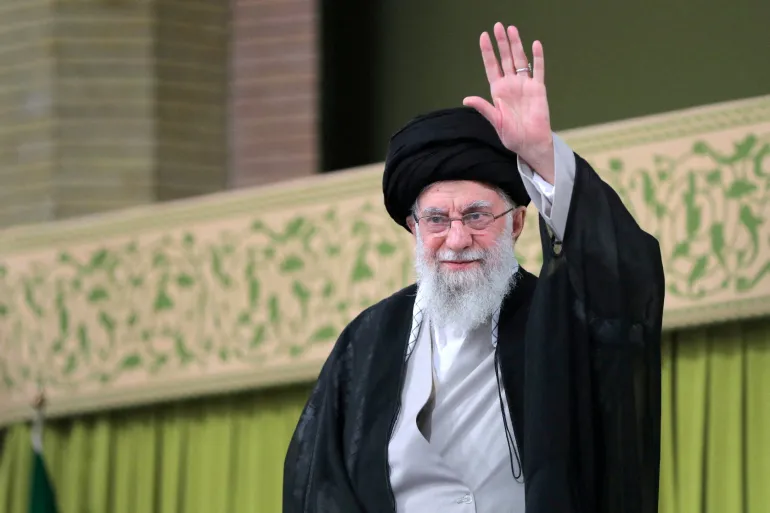
Iran has confirmed that its Supreme Leader Ayatollah Ali Khamenei has been killed in joint US-Israeli strikes on Tehran.
Iran’s state television confirmed the death of Ali Khamenei in an emotional broadcast, with an anchor reading the announcement through tears.
“After a lifetime of Hosseini struggle, unceasing and untiring, with a lofty and celestial spirit like the steadfast mountain of (the Islamic) guardianship, the compassionate father of kindness and resolve, the Leader and Imam of the Muslims, His Eminence Ayatollah Seyyed Ali Hosseini Khamenei, on the path of upholding the exaltation of the sacred sanctuary of the Islamic Republic of Iran, drank the sweet, pure drought of martyrdom and joined the Supreme Heavenly Kingdom,” the statement read.
His death, declared martyredom by a leader who opted to stay in his exposed home compound rather than go into the bunker for protection, has triggered nationwide mourning, vows of revenge from the Revolutionary Guard, and an unprecedented escalation that could reshape the balance of power across the Middle East.
"My body holds little value, my life bears no significance. Even if they kill me, do not count it as our loss. - Ayatollah Khamenei," Khameini said on June 17, 2025, after US President Donald Trump threatened his life by indicating America could trace his exact location and target him.
The 86-year-old cleric becomes the first sitting supreme leader to be killed in the history of the Islamic Republic.
The official IRNA news agency reported that Ali Shamkhani, a top political adviser to Khamenei and secretary of Iran’s Defence Council, was also killed in the strikes. It further said Mohammad Pakpour, commander-in-chief of the Islamic Revolutionary Guard Corps, died in the same attacks.
Fars news agency said the Iranian government has declared 40 days of public mourning and announced seven days of nationwide public holidays.
In a statement carried by Fars, the IRGC said, “We have lost a great leader, and we mourn him.” It described Khamenei’s “martyrdom at the hands of the most vicious terrorists and executioners of humanity” as “a sign of the legitimacy of this great leader and the acceptance of his sincere services.”
The Guard warned that the “Iranian nation’s hand of revenge…will not let them go,” adding that it would stand “firm in confronting domestic and foreign conspiracies.”
In a subsequent statement, the IRGC announced the start of what it called “the most devastating offensive operation in the history of the Islamic Republic of Iran.” The offensive would begin in “just moments,” it said, targeting the “occupied territories [Israel] and American terrorist bases” in the region.
The killing marks the most dramatic escalation in a chain of events that analysts trace back to January 2020, when the United States killed Qassem Soleimani, commander of the Quds Force, in a drone strike ordered by then US President Donald Trump. That strike shattered assumptions about deterrence at the top of Iran’s security establishment.
Subsequent years saw further high-profile assassinations, including that of Ismail Haniyeh in Tehran and Hassan Nasrallah in Lebanon, according to Iranian-linked reports, deepening tensions across the region.
Khamenei had also faced mounting internal pressures, with sanctions intensifying after Trump withdrew unilaterally from the Joint Comprehensive Plan of Action, the 2015 nuclear agreement between Iran and world powers. The collapse of the deal led to increased economic strain and repeated waves of domestic unrest.
Khamenei assumed leadership in 1989 after the death of Ruhollah Khomeini, who led the 1979 Islamic Revolution. Initially viewed by some as an unlikely successor, Khamenei consolidated authority over 36 years, building Iran into a central anti-US force in the region while strengthening the military and paramilitary architecture that projected Tehran’s influence beyond its borders.
Before becoming supreme leader, he served as president during the 1980–1988 war with Iraq, a conflict that deepened his distrust of Western powers, particularly the United States. Throughout his rule, he frequently denounced Washington as “the Great Satan” and rejected allegations that Iran’s nuclear programme sought to produce an atomic weapon.
As pressure mounted for a new nuclear agreement in 2025, Khamenei condemned “the rude and arrogant leaders of America.” “Who are you to decide whether Iran should have enrichment?” he asked at the time.
President Donald Trump confirmed the death hours after initial reports triggered international confusion. Posting on Truth Social, Trump wrote, “Khamenei, one of the most evil people in History, is dead.”
“This is not only Justice for the people of Iran, but for all Great Americans, and those people from many Countries throughout the World, that have been killed or mutilated by Khamenei,” he added.
Addressing Americans and “those people from many countries throughout the world, that have been killed or mutilated by Khamenei and his gang of bloodthirsty THUGS,” Trump said the Iranian leader had been unable to evade US intelligence systems.
“Working closely with Israel, there was not a thing he, or the other leaders that have been killed along with him, could do,” he said. “This is the single greatest chance for the Iranian people to take back their country.”
Trump claimed Iran had been, in only one day, “very much destroyed and, even, obliterated.”
“The heavy and pinpoint bombing, however, will continue uninterrupted throughout the week or, as long as necessary to achieve our objective of PEACE THROUGHOUT THE MIDDLE EAST AND, INDEED, THE WORLD!” he wrote.
Khamenei’s death opens a succession process within Iran’s power structure, with the Assembly of Experts constitutionally responsible for appointing a new supreme leader. However, the simultaneous killing of senior defence and IRGC figures raises immediate questions about command continuity as Iran signals imminent retaliation.
The assassination of a sitting supreme leader represents an extraordinary rupture in Iran’s political history and could mark the beginning of a far more direct and dangerous phase of confrontation between Tehran, Washington and Tel Aviv.
